A sample engagement — details illustrative.
One question.
One market.
One answer.
A regional consumer-fintech team needed to know whether street vendors in Vietnam would actually adopt a QR-code payment — not whether the idea tested well in a conference room. Here is that study, start to finish: the ask, the routing, the fieldwork, and the brief that came back.
01 The ask
Will a street vendor actually trust a QR code — or just say yes to be polite?
A regional consumer-fintech team was weeks from a launch call: bundle QR-code acceptance into its vendor app for independent street sellers across Vietnam, or hold the feature for a market that had already tested well. Vietnam hadn’t been asked yet — and it’s a different question there. Adoption interviews in a business district don’t tell you what a stall owner in a wet market will actually do with her hands full and a queue behind her.
This is also the case that breaks tooling built for easier markets. Vendors like these rarely fill out web panels or sit for a scheduled call — and the AI personas built to stand in for them are least reliable exactly here. Across 65 nations, GPT–human response similarity falls as cultural distance from the US grows — r = −.70. What the research literature bluntly calls “WEIRD in, WEIRD out.” A synthetic panel would answer fluently. It just wouldn’t be answering as her.
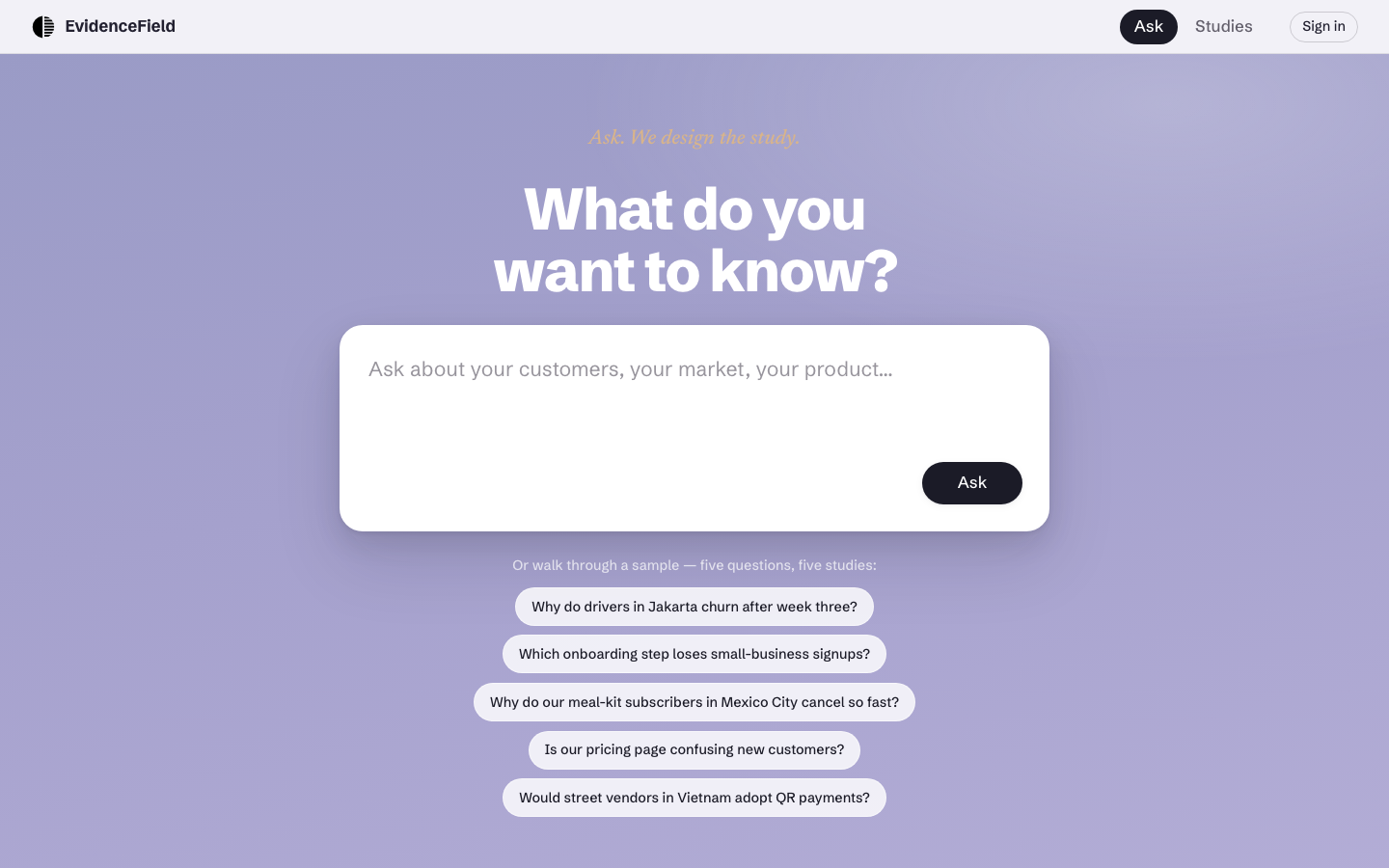
Screens throughout are the real product.
02 The routing
So the study didn’t run one playbook. It split down the middle.
EvidenceField’s research-design layer doesn’t default to synthetic panels, and it doesn’t default to human fieldwork either — it routes each study to the mode the market and the question actually need. For informal-economy vendors in Vietnam, on a decision this consequential, the routing call was AI-augmented human fieldwork as the primary track, with a synthetic pre-screen used only to debug the discussion guide overnight — the one place a synthetic panel reliably earns its keep, not the place that answers the client’s question.
- Primary track
- AI-augmented human fieldwork
- Synthetic used for
- Discussion-guide pre-screen only
A polite yes is not adoption.
03 The field
Recruitment happened at a market stall, not a screener link.
A local field team worked three cities in person — walking market rows, approaching vendors directly, screening for the mix that mattered (mobile-money history, stall type, years trading) without assuming anyone could complete an online form. Interviews ran in Vietnamese. Same-day, AI-augmented transcription and translation turned raw audio into clean bilingual transcripts; a human synthesis lead read across all three cities for the patterns no single interview would show on its own.
- 24
- in-depth interviews
- 3
- cities — Hanoi, Da Nang, Ho Chi Minh City
- 11
- days in the field
Illustrative fieldwork scale for this sample.
04 The answer
Vendors don’t distrust the QR code. They distrust losing the sale when the signal drops.
The brief’s recommendation: build an offline-capable confirmation step before spending the budget on a trust campaign. The adoption barrier wasn’t belief in the technology — it was the ninety seconds a spotty connection leaves a vendor standing in front of a customer with nothing to show for the tap.
- Field interviews, in Vietnamese
- Discussion-guide pre-screen
- Cited synthesis
Your market has an answer.
We just have to go and run the study that finds it.
Start a study